

By Cindy Hadish/for the Corridor Business Journal
Iowa farmers markets could be a refuge from food inflation, at least in the short-term.
Surging fuel prices, fertilizer that has risen nearly 50 percent since the war in Iran began and other input costs that affect farmers won’t necessarily translate to higher prices for local market-goers.
Find more than 50 Eastern Iowa farmers markets: homegrowniowan.com/farmers-markets/
“We’ll be keeping our prices the same,” said Denny Rehberg, who raises purebred Hampshire hogs with his wife, Lea, on their farm in rural Walker, a small community in northern Linn County.
Prices for their top-selling bacon, pork chops, tenderloins, sausages and other favorites sold by Rehberg’s Pork at Hiawatha, Marion, Iowa City and downtown Cedar Rapids markets will likely hold steady, with the couple absorbing costs of higher inputs as long as they’re able, he said.
Mr. Rehberg noted that most of their farm essentials are purchased a year in advance, and the locker where the meat is processed is keeping expenses reasonable. The farm uses no antibiotics or hormones, and grow their own non-GMO grain to feed the Hampshire hogs, a private purebred herd raised unconfined.
Family members also sell popular breakfast sandwiches at the Downtown Farmers Market in Cedar Rapids, as well as in Hiawatha. All four of the markets have opening days in May, keeping the family on the road, with higher fuel prices, as they split their time between the markets.
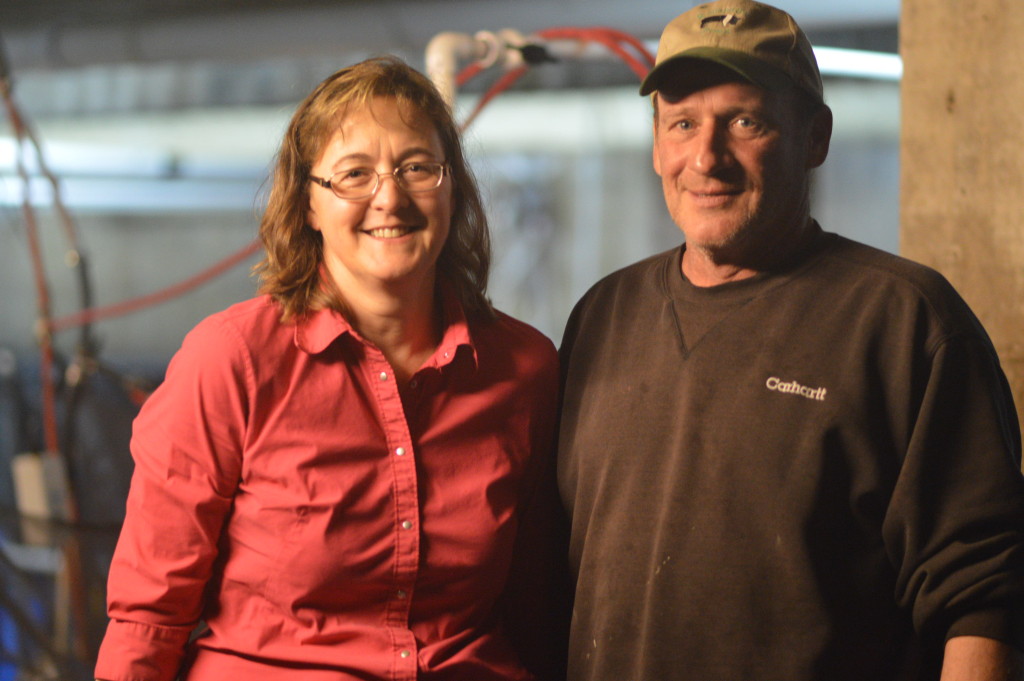
Lea and Denny Rehberg farm in rural Walker, Iowa. (photo/Cindy Hadish)
Hiawatha market manager Dawn Ewoldt said more than 50 vendors are scheduled for the well-attended weekly Sunday markets.
“I have a full house,” she said, adding that 11 vendors are on a waiting list. “We want to expand because we’re getting so much interest.”
Though she was unsure if others will follow suit in maintaining their prices, Ms. Ewoldt said none of the farmers have dropped out – the market also features bakers, artisans and other vendors – so rising input prices “doesn’t seem to have affected them.”
Keith Bloomer, a produce vendor at the Hiawatha market, as well as in West Liberty and Marion, said he will try to maintain prices, even as he is taking a hit on several fronts, including diesel that he uses for his trucks, up in April to $5 per gallon compared to $3.50 last year.
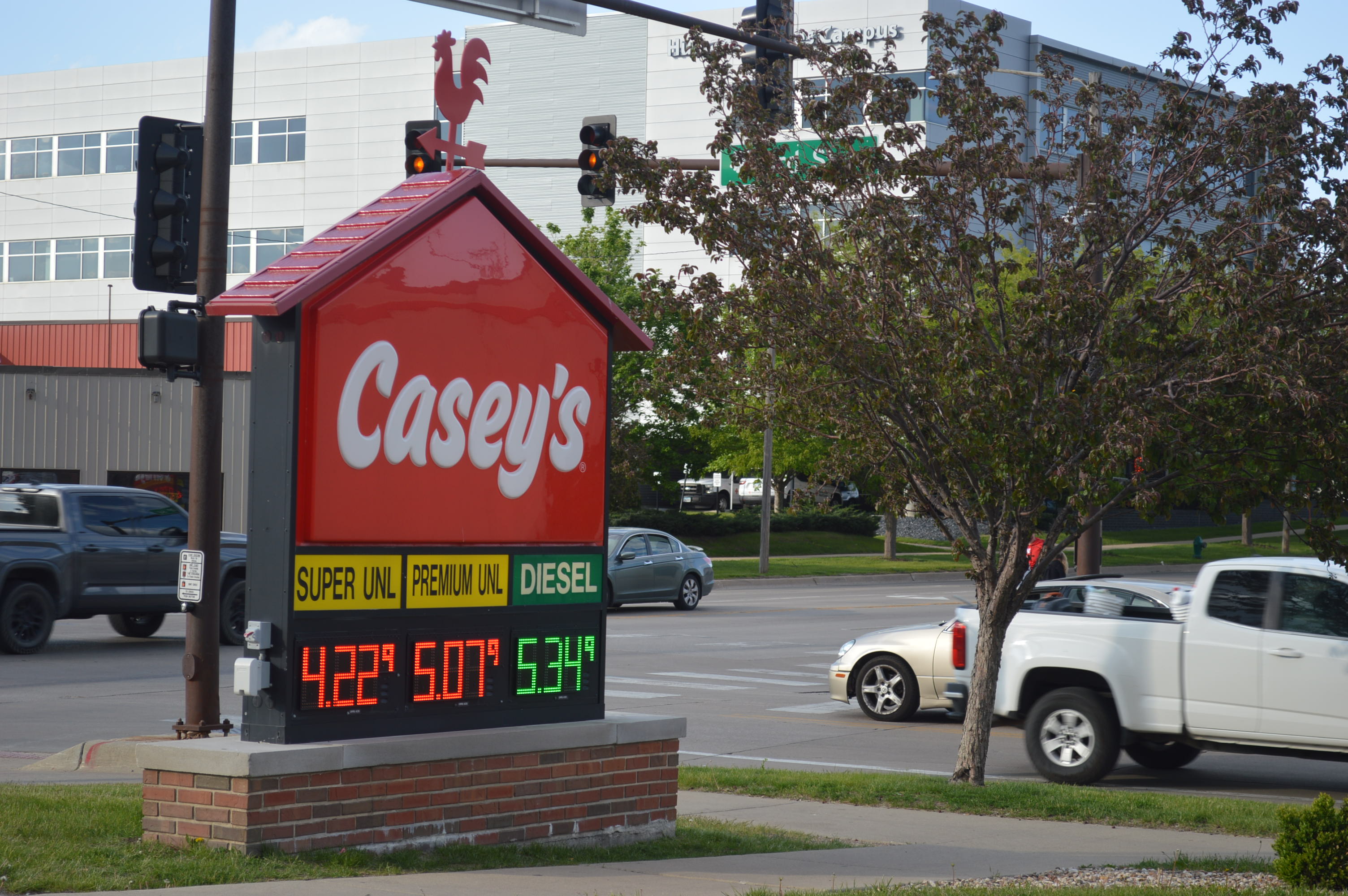
Gas prices are shown in May 2026 in Cedar Rapids, Iowa. (photo/Cindy Hadish)
“I’m going to try to hold to what I had last year,” he said, citing prices on his tomatoes, cucumbers, squash, green beans, watermelon, sweet corn and numerous other crops he grows on about 44 acres near Conesville, in southeastern Iowa. “I’ve got a lot of customers who don’t have a lot of money who come and see me. Everyone’s having a hard time and I don’t want to raise my prices unless I have to.”
Still, Mr. Bloomer looks at his bottom line, he said, so he doesn’t become one of the growing number of farmers filing for bankruptcy nationwide.
According to the American Farm Bureau Federation, 315 farm bankruptcies were filed last year, up 46 percent from 2024, as declining farm income, rising debt and higher costs strained farmers.
Iowa and other Midwestern states led with 121 Chapter 12 bankruptcy filings in 2025, up more than 70 percent over the previous year.
“The most recent farm income forecast confirmed that the farm economy has faced extreme financial pressure, with little relief in sight,” the group noted in its Market Intel report from earlier this year. “Significant losses are expected across crop sectors for another year, and many livestock sectors are also tightening margins.”
Mr. Bloomer has seen that squeeze not only in fuel prices, but in the cost of equipment repairs – he has already spent $20,000 on repairs since last year – and other inputs, such as fungicides, pesticides and commercial fertilizer.
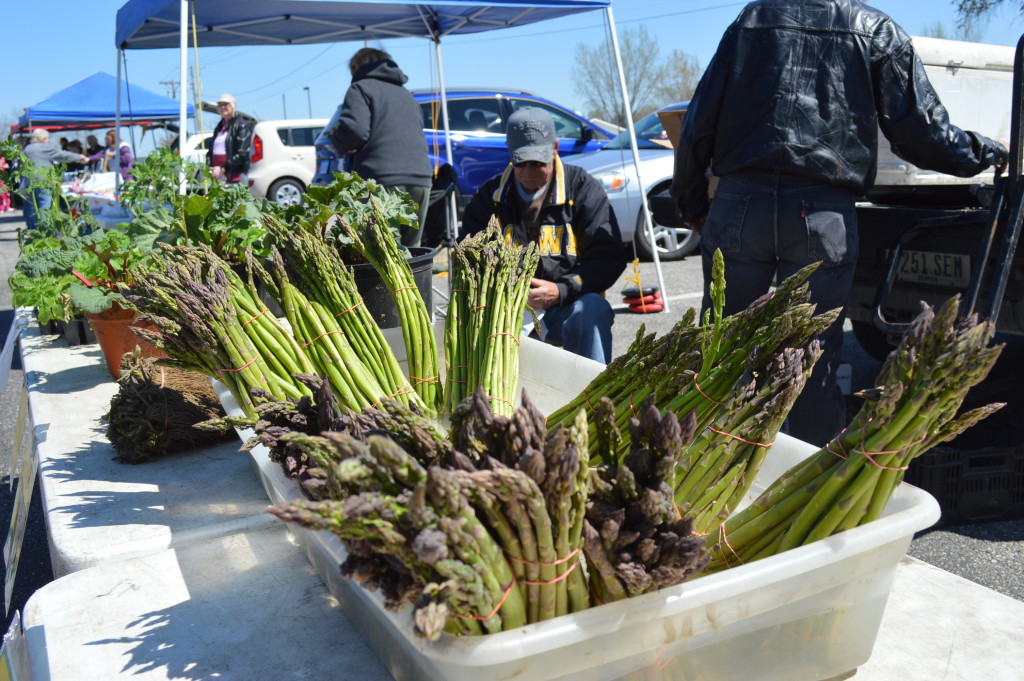
Asparagus, sold at the Hiawatha farmers market during a past season, is among the produce found at farmers markets at this time of year. (photo/Cindy Hadish)
About one-third of the world’s fertilizer supply passes through the Strait of Hormuz, which has been closed for months under the United States and Israeli war against Iran.
Seed prices also have escalated, with some of Mr. Bloomer’s favorite tomatoes costing about $1 per seed, and the price of germinating seed at off-site greenhouses went up from $10 to $14 per tray this year, he noted.
Those increases add up, and the cost of labor is also on the rise. For example, hiring workers to pick strawberries went up from $10.50 per hour in 2024 to $15 last year, and an asking rate of $18 per hour this year, he said.
“The inputs are out of this world,” Mr. Bloomer said. “It’s all risk, and the reward is less than going to the casino.”
Whether or not farmers dropping out is the reason, at least two Eastern Iowa markets will be on hiatus this year.
Belle Plaine and Dysart are ending operations, at least for the season.
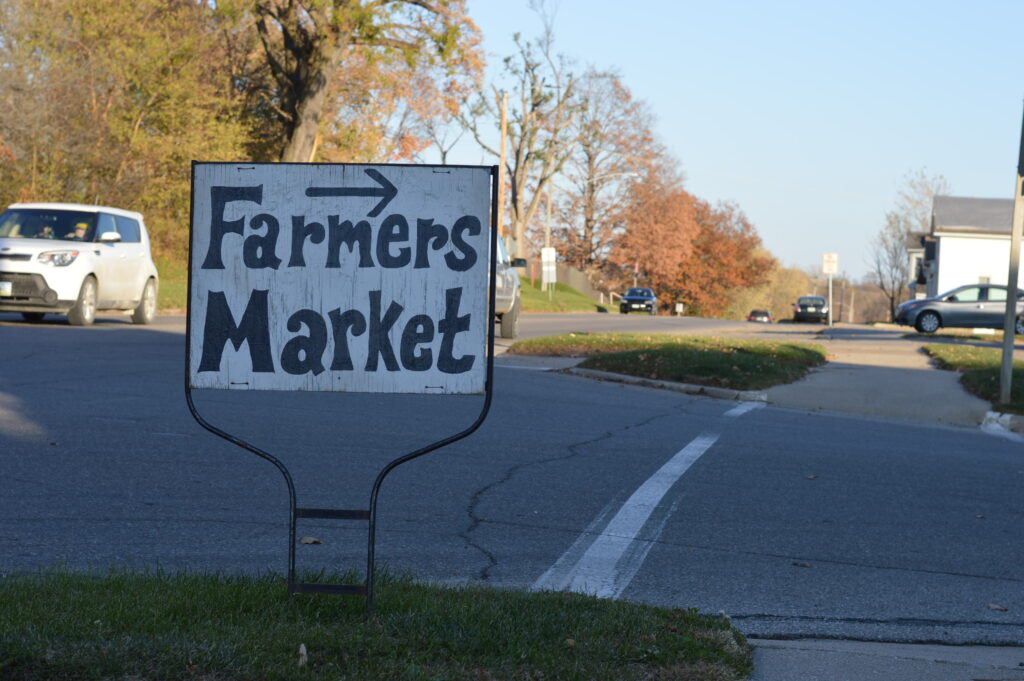
A sign points to the farmers market in Belle Plaine, Iowa, during a past season. The market has suspended operations for 2026. (photo/Cindy Hadish)
“No customers and no vendors,” said Nancy Weise, who helped run the longtime Belle Plaine market, where she sold her own baked goods and vegetables.
And while Dysart’s farmers market at City Park has been suspended for this summer, the Dysart Country Club is starting its own market on the first and third Thursdays of the month.
“We’re hoping to pick up that torch locally,” said Sevana Keffer, a baker who is helping to launch the new market.
Farmers markets in some smaller towns don’t directly compete with grocery stores, where food inflation is tangible.
“We don’t have any grocery stores here,” said Bobbie Cunningham, who manages the Harpers Ferry farmers market, in northeastern Iowa.
Tourists visiting the riverside town augment the locals who shop for wine, baked goods, honey and more at the Friday night markets, she said, keeping the 20 or so vendors in business.
In Coralville, market manager Kristie Wetjen said she expects 20 to 25 vendors weekly at the Wednesday night markets that begin in June, “with quite a few new ones.”
Customer turnout at the Iowa River Landing, where the market is located, could be boosted with a free group walk, run, or bike ride held in conjunction with the market, she said, while interest remains high in buying local foods.
Ms. Wetjen cited transportation costs of produce and other food as “a huge part of what you pay at the grocery store,” she said. “I think inflation and frustration with prices at the stores will help the markets.”
See more at the Corridor Business Journal

No Comments Yet